Insights

Precision farming and technology: progress and evolution

29.07.2026
agricolturadiprecisione_blog

What is precision agriculture?

According to the literal definition of “precision agriculture”, it follows that “Precision agriculture is a management strategy that collects, processes and analyses temporal, spatial and individual data and combines them with other information to support management decisions based on estimated variability, to improve resource use efficiency, productivity, quality, profitability and sustainability of agricultural production”.


The right approach

Speaking therefore not only about the instruments involved, but also about the actual strategy, it is easy to understand that the correct approach cannot be only mechanical and technological, but that alongside all this there is the need for a real management of the variables measured that can lead to results that are useful in determining decisions.

Nowadays, the sector undoubtedly has the technical and IT means to do this. It is basically a question of taking a moment to think, considering the potential technology already available or to be acquired, and then clearly planning the direction to take.

The evolution of “Precision Farming”

This requirement has always been clear to the scholars and pioneers of Precision Farming, even if the availability of technology has not always been accompanied by the same capacity to process information. By digressing briefly from a well-known problem, the question of whether the chicken or the egg was born first could be transfigured. Ontologically, according to Aristotle, the act is always before the potency because everything, in order to pass from potency to act, needs something that is in fact already in act. According to Aristotle, the hen is the act and the egg is the potency, that is, a hen in potency… and so his answer is that the hen comes first.

In today’s ever-evolving and increasingly precision agriculture, we might ask ourselves whether the means (including systems and sensors capable of collecting significant amounts of valuable data), or the software and platforms dedicated to the management of the data themselves and capable of bringing out their still unexpressed potential value, came first. From our experience we can say that the sensors are the act and that the possibility we now increasingly master of effectively managing the data collected by the sensors is in fact the power.

Agriculture 4.0: when agriculture and IOT technology come together

We can say that today we are facing advanced agriculture: agriculture 4.0. Today the technological tools for this sector are increasingly consolidated and available:

01

more advanced GPS antennas

02

satellite photos

03

sensors to determine the crop yield in the field or for the qualitative assessment of soils, crops and effluents

We are witnessing an ever-increasing amount of IT tools available to professionals in the sector and to all the players in the agro-livestock supply chain, which are necessary to concentrate and unify the available data, transforming them into useful and concrete decisions.

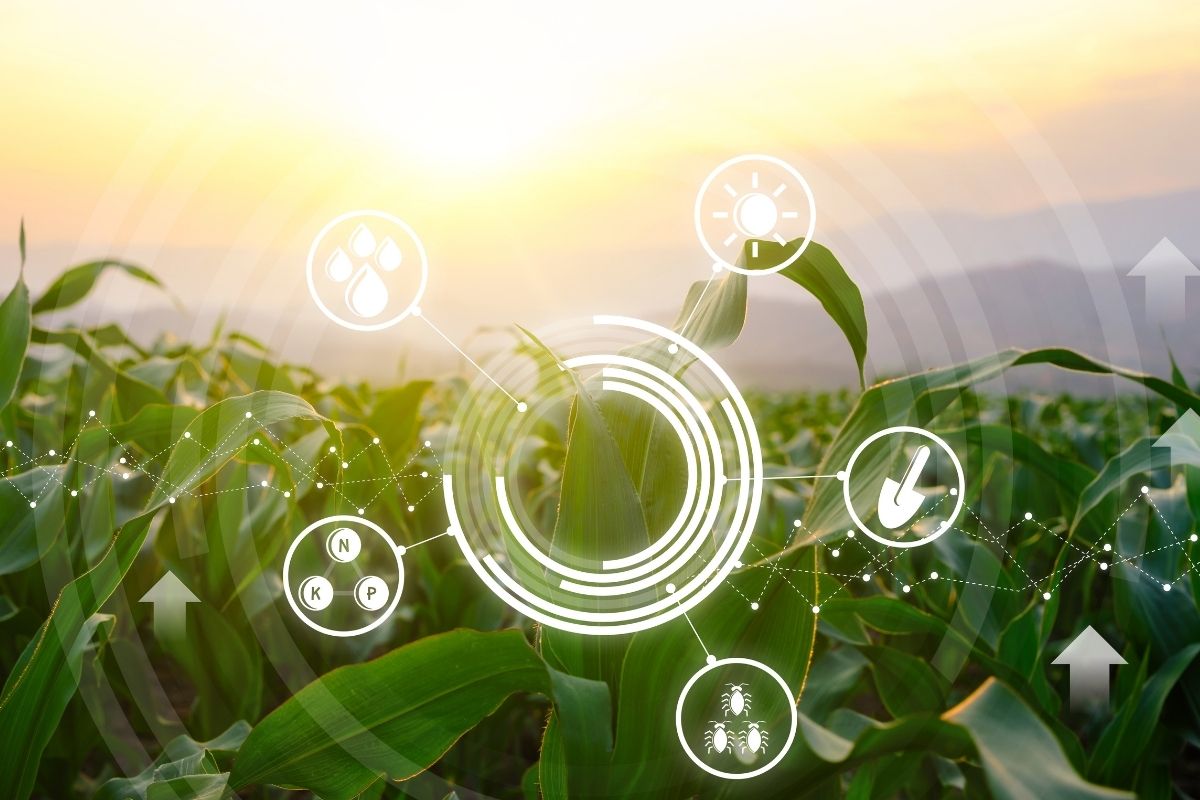
Through the applications of the “Internet of Things”, Precision Farming is able to provide and manage more information, in a more accurate and timely manner, allowing the automation of otherwise unrelated production activities and thus achieving what can be called the Internet of Farming.

The result of the fusion between Precision Agriculture and Internet of Farming leads to what is defined as Agriculture 4.0, that is the harmonious and interconnected use of different technologies aimed at improving the yield and sustainability of crops, production quality, processing processes and working conditions.

Our approach

Also ITPhotonics, throughout its journey, has chosen to work to be an integral part of this development, ensuring from the outset that all its systems intended for the world of precision farming can be versatile, plug-in and Isobus compatible. All this to allow the data measured directly on the machines for harvesting, for the preparation of agricultural land and for the spreading of wastewater are processed by the machine console and then georeferenced and stored by the task controller for subsequent processing. Today our commitment continues, giving substance to what has been done so far, also through the definition of profitable relationships with the most modern companies developing the Internet of Farming, to offer its customers greater compatibility with data processing platforms and better ease of use of their systems.

Digitalization, Precision Farming or Agriculture 4.0? For ITPhotonics, it’s simply called progress.

agricolturadiprecisione_blog

Follow our LinkedIn page

to get fresh updates about our products and solutions!

Other insights
Insights, Featured
Polispec NIR and AlgoMilk: technology at the service of animal farming
Discover how the integration of Polispec NIR with the AlgoMilk platform provides farmers with a technological solution to analyse feed rations, monitor feeding practices and herd data, and optimise livestock management, production efficiency and costs.
29.07.2026
Applications, Insights
NIR Spectrophotometer and calibration curve: differences and uses
What is more important between the NIR instrument and the calibration curve? We could answer this question as follows: a good driver will never be first if he does not drive a good vehicle,and a good vehicle will never be first to the finish line if it is not driven by a good driver!
30.07.2026
Applications, Insights
NIR spectrophotometers: are they all the same?
Choosing a spectrophotometer can often be more difficult than expected. The difficulty lies in the fact that NIR spectrophotometers are not all the same and it is essential to choose the most suitable one for the intended use.
30.07.2026
Applications, Insights
NIR spectrophotometry: areas and fields of application
Near InfraRed (NIR) spectrophotometry is an extremely versatile analytical technique that can determine the chemical composition of the product being analysed by exploiting the interaction of light energy with the molecules that make up the product. But where can it be used?
29.07.2026